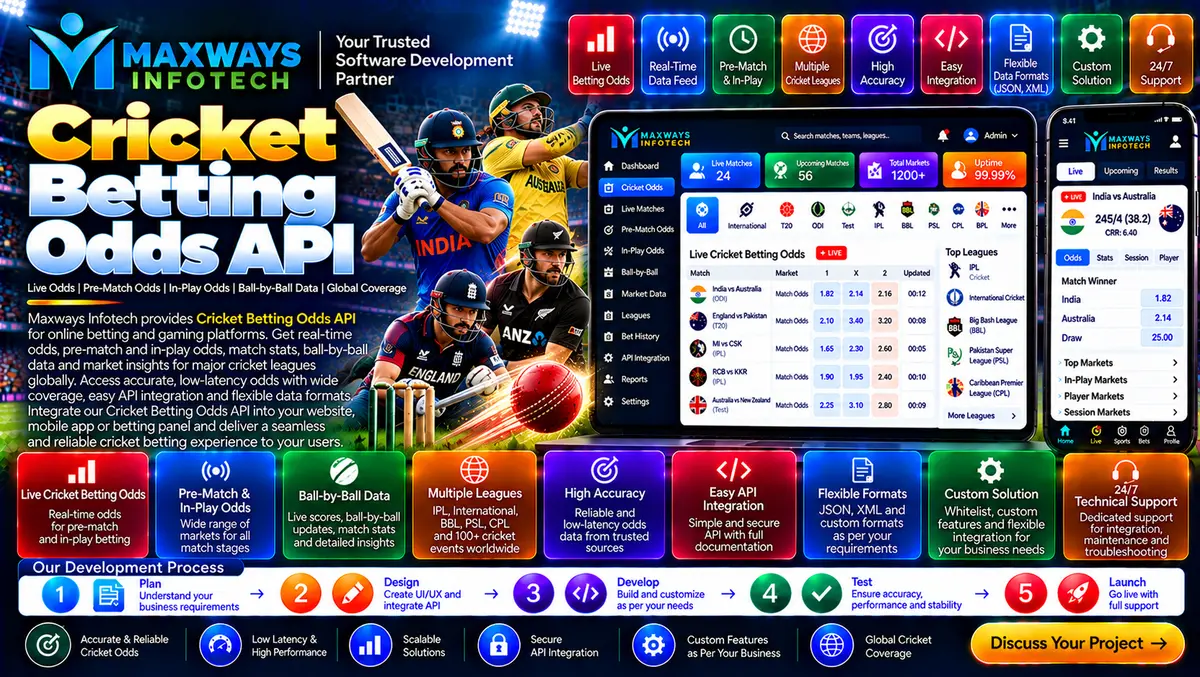
Learn about Cricket Betting Odds API integration, decimal and fractional odds, overround calculations, market status, data validation, security, and licensing.
Cricket Betting Odds API: Understanding Market Rules, Price Formats, and Data Validation
A Cricket Betting Odds API provides structured odds information that developers can integrate into sports data applications, comparison tools, research dashboards, and other permitted software products. But receiving an odds value from an API is only one part of building a reliable application. The software must also understand what the price represents, which rules apply to the market, how different odds formats are converted, and what happens when a cricket match is interrupted.
These details matter because cricket has several formats, from T20 and ODI matches to five-day Test matches. Rain delays, reduced overs, tied matches, and changes to playing conditions can affect how individual markets are interpreted. A well-designed integration must preserve this context rather than treating every odds value as an isolated number.
Businesses exploring sports technology can visit Maxway Infotech to review the company's published information and broader technology focus. The right API implementation should begin with clearly defined requirements, accurate data handling, and confirmation that the intended use is permitted.
What Is a Cricket Betting Odds API?
A Cricket Betting Odds API is a software interface that makes supported cricket odds data available to an application. Depending on the provider, the response may include:
-
Match and tournament identifiers.
-
Bookmaker or data-source information.
-
Market names and selection identifiers.
-
Odds values and their formats.
-
Market status and timestamps.
-
Pre-match or in-play indicators.
-
Historical observations or result information, where supported.
An API may deliver these fields through HTTP requests, streaming connections, or other documented methods. The available functionality depends on the provider and subscription.
For developers, the objective is to transform the supplied information into a consistent format that the application can validate, store, analyse, and display. This requires understanding both the numerical price and the rules surrounding it.
1. Understand Decimal, Fractional, and American Odds
Different services may represent odds using different formats. If an application combines information from multiple sources, it must recognise these formats before performing calculations or displaying comparisons.
Decimal odds
Decimal odds show the total return for each unit staked, including the original stake.
The implied probability is calculated as:
[
P=\frac{1}{O}
]
Here, (O) represents decimal odds.
For example, decimal odds of 2.00 correspond to an implied probability of 50%. Decimal odds of 4.00 correspond to 25%.
These are implied probabilities derived from prices, not guaranteed outcomes or necessarily unbiased estimates of the true probability.
Fractional odds
Fractional odds express potential profit relative to the stake. For fractional odds (a/b), the implied probability is:
[
P=\frac{b}{a+b}
]
For example, fractional odds of 3/1 correspond to an implied probability of 25%.
American odds
American odds use positive and negative values. Positive odds indicate potential profit on a 100-unit stake, while negative odds indicate the stake required to generate a 100-unit profit.
For positive American odds (A):
[
P=\frac{100}{A+100}
]
For negative American odds (A), using its absolute value:
[
P=\frac{|A|}{|A|+100}
]
An application should store the original value and its documented format. Convert it to a standard internal representation only after validating the source data.
2. Calculate Market Overround Correctly
One of the most useful concepts in odds analysis is the overround. It helps describe the combined implied probabilities represented by the prices in a market.
For a market with (n) mutually exclusive outcomes, calculate each outcome's implied probability and add them together:
[
S=\sum_{i=1}^{n}\frac{1}{O_i}
]
For decimal odds, the overround percentage is:
[
\text{Overround}=(S-1)\times100
]
Consider a hypothetical two-outcome market with decimal prices of 1.90 and 1.90.
The implied probability for each outcome is approximately 52.63%. Their sum is approximately 105.26%, producing an overround of 5.26%.
This calculation can help analysts understand the relationship between quoted prices and the combined implied probabilities. It should not be interpreted as a guaranteed profit margin or as a complete measure of the source's commercial terms.
The calculation also depends on using the correct set of mutually exclusive outcomes. For markets with different structures, incomplete outcomes, or special settlement conditions, a simple overround calculation may be misleading.
3. Validate Odds Before Displaying Them
A successful API response does not necessarily mean that every field is valid or suitable for display. Applications should apply validation rules before sending data to the user interface.
A useful validation process checks:
Numeric values: Confirm that the odds field contains a valid number in the documented format.
Range rules: Reject values that are invalid under the provider's schema or the application's requirements.
Market identity: Confirm that the price belongs to the intended event, market, and selection.
Timestamp: Check that the observation time is present and parseable.
Market status: Distinguish between active, suspended, closed, and other documented states.
Source consistency: Retain the provider or bookmaker identifier so that prices are not attributed to the wrong source.
Duplicate records: Identify repeated messages or observations to prevent unnecessary processing.
For example, an application should not display a suspended market as though its prices were available for use. Likewise, a missing price should not silently be converted into zero, because zero may have a different meaning in calculations or visualisations.
Validation rules should be documented and tested against representative API responses, including incomplete or unexpected data.
4. Account for Cricket-Specific Market Rules
Cricket has several situations that make market interpretation more complicated than simply checking the final score.
Rain and reduced-overs matches
Rain may shorten a match or change the target under the applicable playing conditions. A market relating to the match winner may have different conditions from one relating to a specific innings total or number of overs.
Tied matches and Super Overs
A tied match may be resolved through a Super Over, depending on the competition rules. The software must establish whether the market's definition includes that process or treats it separately.
Abandoned matches
A match may be abandoned without producing a conventional result. The outcome of each market depends on its documented rules and the relevant provider's data.
Test match draws
Test matches can end in a draw, unlike many limited-overs matches. A data model that assumes every match has only two possible outcomes can therefore be incomplete.
The important lesson is to preserve market definitions and applicable settlement rules. Developers should not infer an outcome from the final score alone when the relevant market has additional conditions.
5. Separate Price Changes From Market Status Changes
Odds values and market status are two different kinds of information.
A price change indicates that the quoted value has changed. A status change indicates that the market itself has moved into a different state. These events should be handled independently.
For example, a provider may report that a market has been suspended. Even if the last recorded price remains in the response, the application should not automatically treat it as an active price.
6. Design an Integration That Handles Errors
An odds integration should expect temporary failures, incomplete responses, and request limits. The application should handle these conditions without misrepresenting the data.
A practical design includes the following elements:
-
Timeout handling: End requests that exceed a reasonable configured limit.
-
Controlled retries: Retry eligible failures using documented rules and backoff.
-
Rate-limit management: Respect provider limits instead of repeatedly sending rejected requests.
-
Schema validation: Check that the response contains the expected fields and types.
-
Logging: Record useful diagnostic details without exposing credentials.
-
Fallback behaviour: Show an appropriate unavailable or stale-data state when fresh information cannot be confirmed.
If the application stores a previously received price, it should also record when that value was last updated. Cached data must not be presented as current without an appropriate freshness check.
These practices are useful for comparison dashboards and research tools as well as other permitted applications that depend on external data.
7. Protect API Credentials and User Data
Private API credentials should remain on a secure server and should not be embedded in publicly accessible browser code or committed to a public source-code repository.
The integration should use encrypted connections, restricted permissions, and a documented credential-rotation process. Logs should avoid exposing API keys or other secrets.
If the application also manages accounts or other sensitive information, its access controls should reflect the purpose of each component. Data collection, analysis, and administrative functions should not automatically share unrestricted permissions.
Teams working on financial or data-intensive applications can explore Maxway Infotech's fintech information for broader context on software development. Specific security requirements should still be based on the project's architecture, risk assessment, and applicable obligations.
8. Build a Testing Plan Around Real Cricket Scenarios
Testing only a normal match response leaves important gaps. Developers should include a range of scenarios before deploying an integration.
The test environment should use the provider's documented sandbox or representative test data where available. Keep a record of expected and actual results so that regressions can be identified when the integration changes.
9. Check Licensing and Permitted Use
An API subscription does not automatically authorise every use of the information it supplies. Providers may impose restrictions on storage, redistribution, commercial display, attribution, and the territories in which data can be used.
Before launching an application, verify the relevant licence and obtain permission for any use that is not clearly covered by the agreement.
If the intended product includes betting or real-money functionality, seek qualified legal advice on applicable laws and licensing requirements in each relevant jurisdiction. Businesses targeting India should pay particular attention to current rules concerning online money gaming and related activities. Technical access to an API is not proof that a business model is lawful.
For a statistics, research, or media application, confirm the data rights that apply to that specific purpose as well.
Frequently Asked Questions
What is a Cricket Betting Odds API used for?
It can supply structured odds information for supported cricket events and markets. Developers may use permitted data in comparison interfaces, research dashboards, sports analytics applications, and other products according to the provider's licence.
Why should an API support different odds formats?
Different sources may use decimal, fractional, or American odds. Recognising the source format prevents incorrect conversions and helps ensure that displayed values and probability calculations are interpreted consistently.
What is overround in cricket odds?
Overround is the amount by which the sum of implied probabilities for a defined set of outcomes exceeds 100%. It is a descriptive market measure and should not be treated as a guaranteed profit figure.
How should an application handle suspended odds?
It should preserve the market's status and avoid presenting the last recorded price as an active quote. The exact behaviour should follow the provider's documented status definitions and the application's requirements.
Does an odds API guarantee accurate predictions?
No. An API supplies data according to its coverage and documentation; odds values are not guarantees of match outcomes. Data quality, timing, market definitions, and the limitations of probability estimates should all be considered.
Conclusion
A Cricket Betting Odds API is most useful when its data is interpreted correctly. Odds-format conversion, overround calculations, market definitions, status handling, and validation rules all influence how reliable an application will be.
Developers should start by documenting their required fields and supported cricket formats, then test the integration against normal responses and unusual match situations. They should also protect credentials, verify data rights, and ensure that the intended use complies with applicable laws.
For more technology articles and software development insights, explore the Maxway Infotech blog.