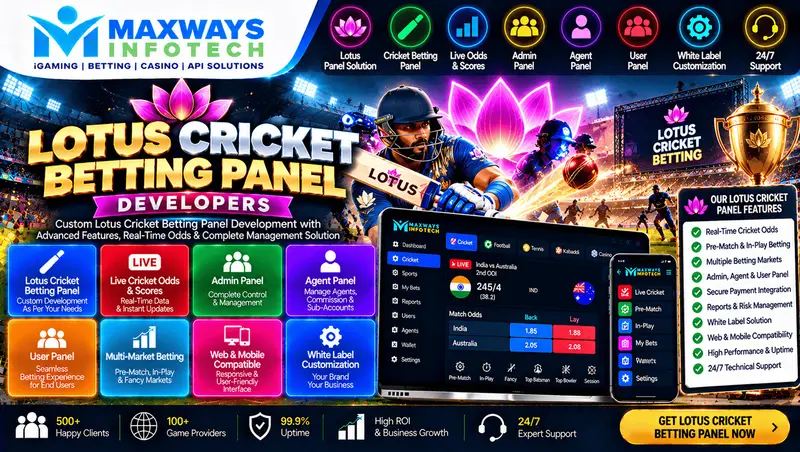
cricket betting website developments, including essential features, cricket API integration, security, technology, SEO, and cost factors.
Cricket Betting Website Development: Features, Technology and Cost Factors
cricket betting website developments involves planning a website's design, backend architecture, data integrations, administration tools, security controls, and ongoing maintenance. Businesses researching this area need to understand how to evaluate development companies, define technical requirements, and select an architecture that can be maintained over time.
A successful project begins with a clear scope. The required functionality, third-party services, expected traffic, security standards, data rights, and legal requirements all influence the development process.
This guide explains the major components of cricket-focused website development, the technologies involved, integration considerations, pricing factors, and how to assess a potential development partner.best cricket betting api provider india | Maxways Infotech
What Is Cricket Betting Website Development?
Cricket betting website development refers to designing and building a cricket-focused platform with the technical components required by its intended use. Depending on the project and the applicable permissions, a website may include sports information, match schedules, score displays, statistics, administrative dashboards, and authorised third-party integrations.
A project may involve:
-
Responsive website design for desktop and mobile users.
-
Cricket fixtures, results, and supported match information.
-
Integration with an authorised cricket data API.
-
Content management and administration tools.
-
Reporting and analytics features.
-
Secure authentication and access controls.
-
Backend services and database management.
-
Monitoring, maintenance, and technical support.
The exact features vary by project. A developer should document which functions are included, which require third-party services, and which would need additional development.
Businesses exploring website and API development can visit MaxWays Infotech to learn about its available services.
Essential Features for a Cricket-Focused Website
1. Responsive User Interface
A responsive interface adapts to different screen sizes and devices. Important information should remain readable, navigation should be straightforward, and controls should work consistently on mobile and desktop browsers.
Design planning should cover loading states, unavailable data, error messages, and pages with long team names or detailed statistics.
2. Cricket Fixtures and Match Information
A cricket website may display schedules, match dates, tournament details, teams, venues, results, and match status where the chosen data provider supports them.
The implementation should display the appropriate timestamps and handle postponed, completed, or unavailable matches correctly. Data coverage depends on the selected provider and subscription.
3. Live Scores and Statistics Integration
An authorised cricket data API may provide live scores, innings summaries, overs, player statistics, scorecards, or ball-by-ball information.
Before integrating a feed, verify:
-
Which competitions and formats are covered.
-
Which data fields are available.
-
How frequently updates are delivered.
-
Whether historical information is included.
-
What request limits apply.
-
Which display and commercial uses are permitted.
For more information about cricket data connectivity, visit the Cricket API Provider page.
4. Administration Dashboard
An administration dashboard helps authorised staff manage supported website settings, content, user permissions, and operational reports.
Its scope should be defined before development begins. Privileged operations should use appropriate access controls, and important administrative changes should be recorded for auditing.
5. Database and Backend Architecture
The backend handles application logic, validates incoming data, communicates with external services, and supplies information to the frontend.
The database should be designed around the project's actual requirements. Developers should plan data retention, backups, recovery procedures, indexing, and access permissions as part of the initial architecture.
6. Reporting and Analytics
Reporting tools can organise operational information into useful summaries. Depending on the application, reports might cover content updates, system activity, API performance, or website traffic.
Every report should use clearly defined metrics and appropriate access restrictions. Incomplete or delayed information should not be presented as current or definitive.
How Cricket API Integration Works
A cricket data API allows compatible applications to request information from a third-party service. The integration should follow the provider's documentation, security guidance, usage limits, and licence conditions.
Step 1: Define the required data
Identify the match formats, competitions, statistics, and response fields the website needs. Avoid purchasing a package with unnecessary coverage.
Step 2: Review API documentation
Confirm authentication requirements, endpoint availability, response formats, rate limits, update intervals, and permitted uses.
Step 3: Connect the backend
Configure authenticated requests in a server-side application. Private credentials should not be exposed in browser code or public repositories.
Step 4: Validate and map responses
Convert incoming data into a consistent internal format. Handle missing fields, invalid responses, duplicate records, and unexpected data structures.
Step 5: Handle failures safely
Plan for timeouts, rate limits, expired credentials, and external service interruptions. The application should clearly distinguish unavailable or outdated information from current data.
Step 6: Test and monitor
Test normal requests and failure scenarios before launch. Monitor response times, data freshness, and error rates after deployment.
Businesses comparing integration approaches can also review the Sports Betting API resource.
Technology Stack for Cricket Website Development
The technology stack should reflect the project's scale, required integrations, available expertise, and maintenance expectations.
Frontend development: HTML, CSS, JavaScript, and suitable frameworks can be used to build responsive interfaces.
Backend development: A server-side framework handles business logic, authentication, data validation, and API communication.
Database: A suitable relational or document database stores the records required by the application.
API layer: Integration services connect the website with authorised third-party data providers and other compatible systems.
Hosting and deployment: Infrastructure should meet the project's performance, security, backup, and availability requirements.
Monitoring: Logging and monitoring tools help identify integration failures, performance problems, and operational issues.
No single technology stack is best for every project. The development team should explain why its chosen architecture fits the requirements and how the system will be maintained.
Custom Development vs Ready-Made Software
Businesses generally evaluate existing software, custom development, or a combination of the two.
| Factor | Ready-made software | Custom development |
|---|---|---|
| Initial implementation | May be faster when requirements match existing features | Requires planning and implementation |
| Customisation | Depends on product limits and licence | Can follow the agreed project scope |
| Initial investment | May be lower for standard requirements | Depends on complexity and integrations |
| Ownership | Governed by the vendor's terms | Governed by the development agreement |
| Integrations | Limited to compatible services and available access | Can be designed for selected authorised APIs |
| Maintenance | Depends on the vendor's support model | Requires a defined support and maintenance plan |
A hybrid solution can also work. For example, a project might use an existing content management system with a custom integration layer and tailored website components.
Compare total cost of ownership rather than focusing only on the initial development fee.
Security Requirements
Security should be considered from the start of the project, especially when the website includes administrative functionality or handles user information.
Authentication and permissions
Use secure authentication, appropriate session management, and role-based access. Privileged accounts should receive additional protection where appropriate.
API credential protection
Keep API keys and private credentials on the server. Apply least-privilege access and rotate credentials according to the provider's security guidance.
Input validation
Validate user inputs and external API responses. Use established security practices to reduce the risk of common web application vulnerabilities.
Data protection
Collect only necessary information, apply appropriate access controls, and define data retention and deletion procedures.
Backups and recovery
Maintain protected backups and test restoration procedures. A backup strategy should include clear recovery responsibilities.
Updates and testing
Keep software dependencies updated, review security advisories, and test important changes before deployment.
SEO for a Cricket Website
SEO should be planned during website development, not treated as an afterthought.
Important foundations include:
-
Unique page titles and meta descriptions.
-
Clear headings and useful original content.
-
Descriptive, readable URL structures.
-
Relevant internal links between related pages.
-
Mobile-friendly layouts and reasonable page-loading performance.
-
Descriptive image alt text where appropriate.
-
Correct sitemap and canonical URL configuration.
-
Redirects for changed URLs when needed.
Avoid publishing many nearly identical pages simply to target keyword variations. Each page should have a distinct purpose and offer useful information to visitors.
For content planning, connect relevant articles to broader cricket API and development resources. Internal links should help readers navigate naturally rather than repeat exact-match keywords excessively.
Cricket Website Development Cost Factors
The cost of cricket website development depends on the required features, technology, integrations, and ongoing service requirements. There is no universal price that applies to every project.cricket betting api cost and pricing factors | Maxways Infotech
Common cost factors include:
Website complexity: The number of pages, custom interface components, and administrative modules affects development effort.
API subscriptions: Third-party data access may involve separate subscription fees, usage limits, or commercial licensing charges.
Custom functionality: Bespoke workflows, reporting, and integrations require additional design and implementation.
Infrastructure: Hosting, storage, backups, monitoring, and security requirements affect recurring costs.
Quality assurance: Functional testing, integration testing, performance checks, and security reviews contribute to project cost.
Maintenance: Software updates, bug fixes, compatibility changes, and technical support may require an ongoing budget.
Legal and compliance requirements: Requirements depend on the intended service and the jurisdictions in which it will operate.
Ask for an itemised quotation that separates one-time development costs from recurring fees. Request clear deliverables, exclusions, payment milestones, and change-request terms.
How to Choose a Cricket Website Development Company
Selecting a development partner requires evaluating the team's technical process, communication, and support arrangements.
Review relevant technical experience
Ask about projects involving responsive websites, external data integrations, backend systems, or similar technical requirements. Focus on the team's actual responsibilities and approach.
Request a detailed proposal
The proposal should identify the included features, third-party dependencies, estimated milestones, testing requirements, and acceptance criteria.
Check API compatibility
Confirm that the proposed architecture supports the required data provider and that the necessary access permissions are available.
Evaluate security practices
Ask how the team handles credentials, permissions, updates, backups, testing, and security incidents.
Clarify source-code ownership
The agreement should state who owns custom code, design assets, and documentation, along with any restrictions arising from third-party software licences.
Confirm post-launch support
Determine who will handle software updates, integration changes, defect resolution, monitoring, and future enhancements.
For related website-development considerations, read Custom Bookies Website Developers.
Why Consider MaxWays Infotech?
MaxWays Infotech provides software development and API integration services for businesses evaluating custom website and application projects.
When discussing a cricket-focused project, prepare a clear requirements brief covering the intended audience, website pages, required data fields, integrations, technology preferences, security expectations, and ongoing support needs.
A technical consultation can help establish whether an existing solution, custom development, or a hybrid approach best fits the project's requirements. Confirm specific features, timelines, pricing, and service commitments directly with the provider before proceeding.
Frequently Asked Questions
1. What is cricket betting website development?
It refers to building a cricket-focused website and its supporting software components according to the intended project scope. Features and permitted use depend on the requirements, third-party services, and applicable laws.
2. Can a cricket website display live scores?
Yes, if a compatible data provider offers the required information and the application has the necessary access and display rights. Update frequency and competition coverage depend on the provider.
3. Can I integrate a cricket API into an existing website?
Yes, provided the website's technology is compatible and the required API access is available. The work may involve authentication, backend requests, data validation, error handling, and frontend changes.
4. How much does cricket website development cost?
The price depends on website complexity, custom features, API subscriptions, infrastructure, testing, and maintenance. Request a detailed quotation based on your actual requirements.
5. Is custom development better than ready-made software?
Not always. Ready-made software may suit standard requirements, while custom development can provide more control when the project needs specialised functionality. Compare cost, flexibility, ownership, and maintenance.
6. What should I check before selecting a developer?
Review technical experience, project scope, API compatibility, security practices, ownership terms, testing procedures, pricing, and post-launch support.
7. Is SEO included in website development?
SEO can be included in the project scope. Confirm whether metadata, URL structure, internal links, sitemap configuration, mobile usability, and performance optimisation are included in the developer's proposal.
8. Are there legal requirements for cricket betting websites?
Requirements vary by jurisdiction and business model. Obtain qualified legal advice and confirm all necessary authorisations before developing or launching wagering-related functionality.
Conclusion
Cricket betting website development requires careful planning across design, backend architecture, data integrations, security, SEO, and ongoing maintenance. The best development approach is the one that meets the project's genuine requirements while remaining secure, maintainable, and compatible with authorised third-party services.cricket betting website developer | Maxways Infotech
Start with a written scope, evaluate providers against consistent criteria, and test integrations before launch. A clear development and maintenance plan can help reduce avoidable costs and technical risks.
Visit MaxWays Infotech to explore software development and API integration services.
Compliance note: This article is for software-development and technical-planning purposes. Any wagering-related functionality must only be deployed where legally permitted, with required authorisations, appropriate third-party data rights, and applicable consumer-protection safeguards.