Learn how a Cricket Odds Data API supports structured data, historical odds analysis, data normalisation, database design, analytics dashboards, and reliable integration.
Cricket Odds Data API: Data Structure, Historical Analysis and Analytics
A Cricket Odds Data API gives developers a structured way to access cricket-related odds information for websites, sports analytics dashboards, research tools, and authorised data-driven applications. Instead of collecting information manually from different sources, a properly documented API can provide data in a format that software systems can process, store, compare, and analyse.
The value of a Cricket Odds Data API depends on more than the number of records it returns. Developers also need to understand how matches are identified, how markets are organised, how timestamps are recorded, and whether historical information is available. Without these details, even a large dataset can produce unreliable comparisons or misleading analytical results.
This guide explores the data-management side of cricket odds integration, including schema design, historical records, data quality, analytics, and practical implementation considerations.
What Is a Cricket Odds Data API?
A Cricket Odds Data API is an interface for retrieving structured cricket odds information from a data provider. Depending on the service, its response may include match identifiers, participating teams, market categories, available selections, odds values, timestamps, and source information.
The exact fields and coverage vary between providers. Some services offer current and upcoming event data, while others may also provide historical snapshots or bookmaker-specific records.
Common applications include:
-
Cricket statistics and analytics dashboards.
-
Sports data comparison websites.
-
Historical market research.
-
Data visualisation and reporting tools.
-
Statistical modelling and research environments.
-
Licensed sports information services.
Before selecting an API, developers should verify its coverage, update schedule, historical depth, permitted uses, and response format.
Businesses exploring software development capabilities can begin with the Maxways Infotech homepage and review the information relevant to their project requirements.
Understanding the Structure of Cricket Odds Data
A useful data structure preserves the relationship between a cricket match and the odds information associated with it. Treating every odds value as an isolated number makes it difficult to compare records accurately.
A typical conceptual data hierarchy looks like this:
Competition → Match → Data Source → Market → Selection → Odds Value
Each level answers a different question.
-
Competition: Which tournament or series does the event belong to?
-
Match: Which specific fixture is being described?
-
Data source: Where did the information originate?
-
Market: What type of outcome or event does the record describe?
-
Selection: Which option within that market is represented?
-
Odds value: What value was recorded at a particular time?
For example, two odds values may look similar but refer to different matches or different market definitions. Comparing them without checking their identifiers and rules can create an incorrect conclusion.
Why stable identifiers matter
Team names, competition labels, and match descriptions may vary between providers. One source might use an abbreviated team name while another uses its full name.
Stable identifiers help connect these records without relying entirely on text matching. When multiple providers are involved, developers should maintain a mapping table that records the relationship between each provider's event identifier and the application's internal identifier.
This approach also helps prevent duplicate fixtures and makes historical records easier to retrieve.
Normalising Odds Data from Different Providers
Data normalisation means converting information from different sources into a consistent internal format. It is especially important when providers use different field names, timestamp conventions, or market descriptions.
A normalisation process may include:
-
Field mapping: Convert provider-specific fields into a standard internal schema.
-
Identifier mapping: Connect external match and market IDs to internal records.
-
Value validation: Check that numeric values can be parsed and fall within expected formats.
-
Timestamp standardisation: Store timestamps consistently, commonly using UTC internally.
-
Market classification: Map equivalent market definitions only when their rules genuinely match.
-
Source attribution: Preserve the provider and retrieval time associated with each record.
Normalisation should not erase meaningful differences. Two markets with similar labels are not necessarily equivalent if their settlement rules or selection definitions differ.
A good data pipeline preserves the original source record where licensing permits, alongside the normalised representation. This makes it easier to investigate discrepancies and update mapping rules later.
Historical Cricket Odds Data and Its Uses
Current data describes what a provider reports now. Historical data records what was available at an earlier point in time. These are different capabilities, and an API that provides current odds does not automatically include a historical archive.
Historical snapshots can be valuable for research and reporting when the provider supplies appropriate timestamps and sufficient coverage.
Market movement analysis
Researchers can compare snapshots to examine how recorded values changed before or during a match. Each observation should retain its timestamp and source so that the comparison remains meaningful.
Season-level reporting
Historical records can support summaries across competitions, seasons, or match formats. Analysts can examine data availability, market coverage, and patterns in recorded values.
Model evaluation
A research team may use historical datasets to evaluate a statistical model against past observations. The evaluation must avoid using information that would not have been available at the time being simulated.
Data quality investigations
Historical snapshots can help identify missing periods, unexpected jumps, duplicate records, and inconsistent market mappings.
Historical access, retention periods, and snapshot frequency depend on the provider's commercial plan and data rights. Developers should confirm these details before designing an archive around them.
Designing a Database for Cricket Odds Information
A well-planned database should preserve relationships between events, markets, sources, and observations without making every report depend on a large, repetitive record.
A conceptual design may include these entities:
The final schema should reflect the actual API response and intended queries rather than forcing every provider into an identical structure.
For frequently refreshed information, a cache can reduce repeated reads. A relational database may be appropriate for structured records and joins, while an analytical warehouse or time-series-oriented design may suit larger historical datasets.
A practical implementation often uses both operational storage and an analytics layer, with clear rules for how data moves between them.
Improving Data Quality Before Analysis
Data quality determines whether a dashboard or research report can be trusted. Missing values, duplicate events, inconsistent timestamps, and mismatched markets can distort results even when the API request itself succeeds.
Useful validation checks include:
Completeness: Verify that required identifiers, market definitions, and timestamps are present.
Uniqueness: Detect duplicate observations using suitable combinations of source, event, market, selection, and version or timestamp.
Freshness: Identify records that are older than the expected update window.
Consistency: Check that event status, market status, and associated records do not contradict one another.
Outlier review: Flag unexpected values for investigation without automatically assuming that every unusual value is incorrect.
Correction tracking: Preserve the history of material changes when a provider revises previously supplied information.
Data pipelines should distinguish between an invalid record, a missing record, and a valid record that simply has no available odds. These situations require different responses.
Building Cricket Odds Analytics Dashboards
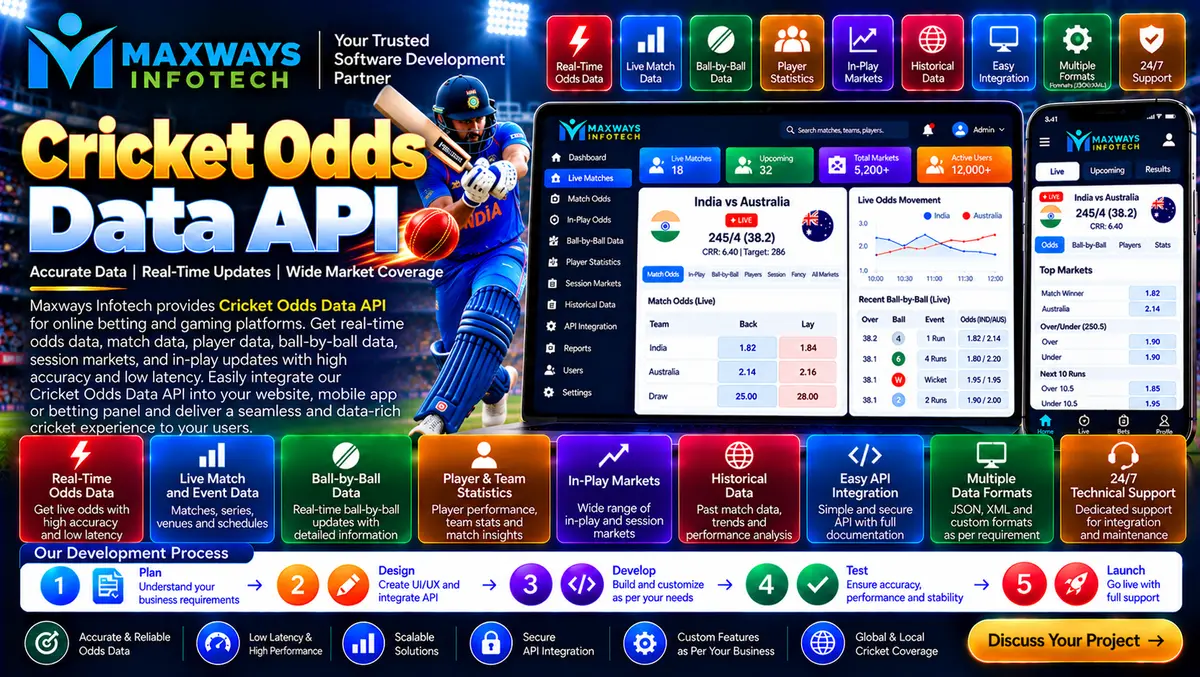
Once the data is structured and validated, it can support dashboards for monitoring coverage, analysing historical observations, and reviewing source quality.
A useful dashboard may include:
-
Match and competition filters.
-
Source and market selectors.
-
Historical time-range controls.
-
Data freshness indicators.
-
Missing-record and error summaries.
-
Historical snapshot charts.
-
Export functions governed by data permissions.
Visualisations should clearly identify the selected time period and source. If a chart combines observations from different providers, its methodology should explain how the records were aligned and whether the market definitions are comparable.
Analytical dashboards should also distinguish descriptive analysis from predictions. A historical pattern does not guarantee a future outcome, and an observed association should not automatically be interpreted as a causal relationship.
For projects that combine data-intensive applications with financial technology, the Maxways Infotech fintech page may be useful when researching related software development capabilities.
API Performance, Storage Costs and Scalability
The amount of data a cricket application processes depends on its competition coverage, number of markets, provider update frequency, retention period, and user demand.
A scalable system should avoid requesting the same information unnecessarily and should store only the data it is authorised and required to retain.
Developers can improve efficiency by:
-
Selecting only the fields needed for the application.
-
Using provider-supported pagination and filtering.
-
Applying caching according to documented freshness rules.
-
Monitoring API quotas and request failures.
-
Separating operational queries from large analytical queries.
-
Compressing or partitioning historical datasets where appropriate.
-
Archiving records according to retention and licensing requirements.
Performance testing should measure the complete workflow, including ingestion, validation, storage, and reporting. Fast API responses alone do not guarantee that the resulting dashboard will load quickly.
Security, Data Rights and Responsible Use
API credentials should be stored securely on the server and should never be exposed in public frontend code. Access permissions should be limited to the functions required, and logs should avoid recording secret keys or unnecessary sensitive information.
Commercial data rights are equally important. A subscription that permits internal API access may not automatically allow redistribution, public display, resale, or long-term archival of every response.
Before deploying a Cricket Odds Data API, verify:
-
Whether the intended competitions and markets are covered.
-
Which uses are permitted by the provider's agreement.
-
Whether historical storage and public redistribution are allowed.
-
How credentials, rate limits, and service access are managed.
-
Which local legal requirements apply to the intended application.
Where a product involves betting-related services, legal review and authorised data access should be completed before launch. Technical availability alone does not establish that a particular activity is legally permitted.
Frequently Asked Questions
What information can a Cricket Odds Data API provide?
Depending on the provider, it may return match identifiers, competition information, market descriptions, selection values, odds, timestamps, and source metadata. The actual schema and available fields must be confirmed in the provider's documentation.
Is historical cricket odds data always included?
No. Historical snapshots may be a separate feature or subscription. Confirm the available date range, snapshot frequency, coverage, and permitted retention before planning historical analysis.
Why is data normalisation important?
It allows an application to process information from different providers through a consistent internal structure. Proper normalisation also reduces errors caused by different field names, identifiers, and market definitions.
Can cricket odds data be used for statistical research?
Yes, when the provider's terms permit the intended use and the dataset is suitable for the research question. Results should account for missing data, timestamps, source differences, and potential selection bias.
What should developers evaluate before selecting an API?
Review data coverage, documentation, identifier stability, historical availability, update schedules, response formats, usage limits, commercial permissions, security, and support arrangements.
For more technical articles and software-related insights, visit the Maxways Infotech blog.
Conclusion
A Cricket Odds Data API becomes more useful when its information is structured consistently, validated carefully, and stored with the context needed for future analysis. Stable identifiers, clear market definitions, reliable timestamps, and historical record management are essential for building trustworthy cricket data applications.
Before starting development, define the questions the application must answer, verify which information the provider actually supplies, and design the data model around those requirements. This approach can reduce integration errors and make future reporting, analytics, and maintenance easier.
Always verify provider permissions and applicable legal requirements before using or redistributing betting-related data.