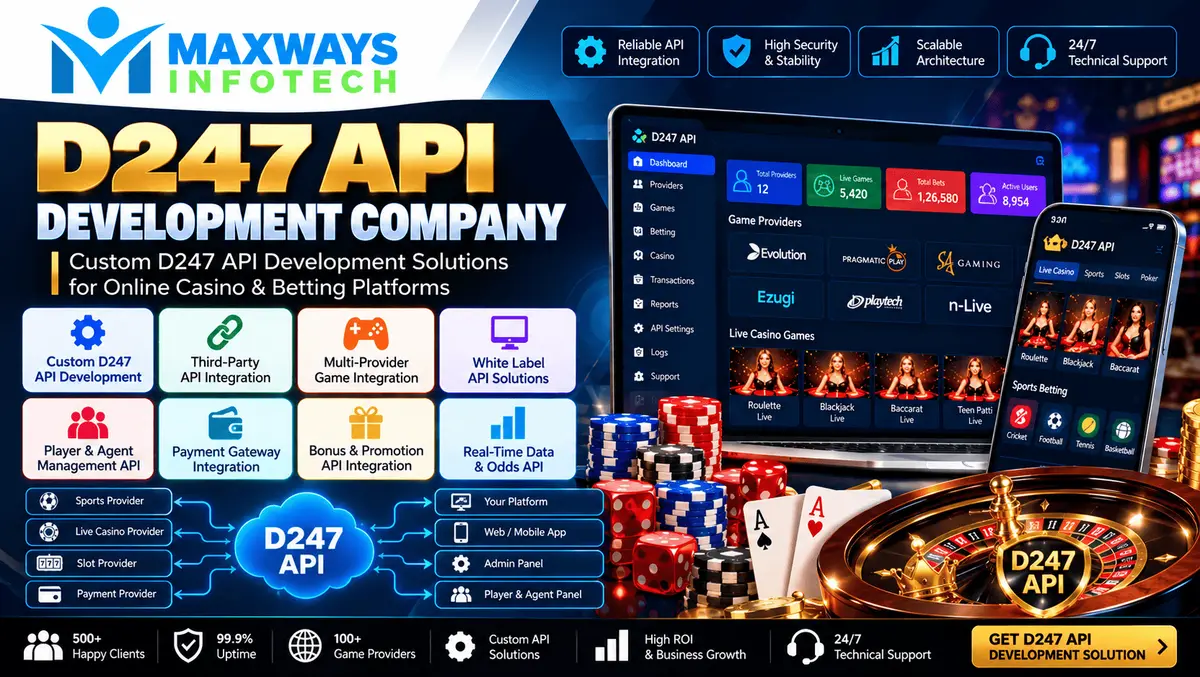
D247 API Development Company, custom API design, secure integrations, data connectivity, testing, documentation, and ongoing technical support.
D247 API Development Company: Custom API Solutions, Integration, and Support
Businesses building connected digital platforms need reliable APIs to exchange information between websites, applications, databases, and third-party services. A D247 API Development Company can help plan, develop, test, and maintain API-based software solutions according to documented technical requirements and authorized access.
API development is not limited to connecting two applications. It also involves defining data structures, protecting credentials, managing errors, maintaining compatibility, and monitoring system performance.
At MaxWays Infotech, businesses can explore information about software development and digital platform solutions. This guide explains what to consider when evaluating an API development company and planning an integration project.
What Does a D247 API Development Company Do?
An API development company creates or customizes software interfaces that allow compatible applications to communicate through defined requests and responses.
Depending on the project scope, services may include:
-
Custom API design and development.
-
Integration with authorized third-party applications.
-
Database connectivity and data transformation.
-
Authentication and access-control configuration.
-
API testing, documentation, and deployment.
-
Performance monitoring and ongoing maintenance.
The specific capabilities available for a D247-related project depend on the software, official documentation, provider permissions, and agreed requirements. Businesses should verify supported functionality before beginning development.
Key Services Offered by an API Development Company
1. Custom API Development
Custom API development creates interfaces around a project's specific requirements. Developers define the endpoints, request parameters, response formats, authentication rules, and error-handling behaviour.
A well-designed API should be consistent, documented, and straightforward for authorized developers to integrate with other applications.
2. Third-Party API Integration
Businesses often use external services for reporting, identity verification, notifications, payment processing, or other approved functions.
An integration team should verify compatibility, review documentation, configure authorized credentials, and test the complete data flow before deployment.
For a related overview, read the d247-api-integration-provider.
3. Database and Backend Connectivity
APIs frequently communicate with databases and backend services to retrieve, validate, or update information.
Developers should establish which system is authoritative for each data field, how transactions are handled, and how conflicting updates are resolved. These decisions help prevent inconsistent records across connected applications.
4. API Modernization
Older interfaces may require updates when security standards, software dependencies, or business requirements change.
Modernization can include improving authentication, updating documentation, introducing versioning, simplifying response structures, and replacing unsupported dependencies.
Changes should be tested for compatibility before existing integrations are migrated.
5. API Testing and Documentation
Testing checks whether an API behaves as expected under normal and exceptional conditions. Documentation explains how authorized developers can use and maintain the interface.
A complete delivery should include endpoint descriptions, authentication requirements, request and response examples, error codes, rate limits, and versioning rules.
6. Ongoing API Maintenance
API maintenance can include security updates, compatibility fixes, performance monitoring, incident investigation, and support for changes introduced by third-party services.
The service agreement should specify which maintenance activities are included and how additional development work is charged.
Important Features of Reliable API Solutions
When evaluating a D247 API development company, consider the following technical capabilities.
Secure Authentication and Authorization
Authentication verifies the identity of an application or user. Authorization determines which resources or actions that identity can access.
Appropriate controls may include token-based authentication, restricted permissions, secure credential storage, and regular access reviews. API secrets should not be exposed in public-facing code.
Clear Data Structures
Consistent field names, data types, timestamps, identifiers, and status values help connected applications interpret information correctly.
Developers should validate incoming requests and return predictable responses so that errors can be handled without creating unnecessary system failures.
Error Handling and Recovery
API requests may fail because of network interruptions, invalid parameters, expired credentials, or external service outages.
Reliable implementations use appropriate timeouts, structured logging, controlled retries, and documented recovery procedures. Duplicate-prevention mechanisms are particularly important when repeating a request could create a second record or action.
Performance and Scalability
API performance depends on factors such as request volume, database queries, network latency, caching, and the behaviour of connected services.
A development team should establish measurable performance requirements and test the API under realistic workloads rather than relying only on successful requests during development.
Monitoring and Auditability
Monitoring helps teams identify failed requests, unusual response times, and recurring errors. Audit records can support investigations and help establish what happened during a particular operation.
Logs should avoid exposing passwords, access tokens, or other sensitive information.
How to Choose the Right D247 API Development Company
Choosing a provider requires reviewing both technical expertise and project management practices.
Evaluate Technical Experience
Ask about the team's experience with API architecture, backend programming, databases, authentication, integration testing, and production deployment.
A provider should be able to explain the proposed design and identify limitations rather than promising that every integration is automatically possible.
Verify API Documentation and Access
Confirm that the required documentation, test credentials, and permissions are available. Any third-party integration should comply with the provider's usage terms and authorization requirements.
Review Security Practices
Ask how credentials are protected, how permissions are assigned, how vulnerabilities are addressed, and how security incidents are handled.
Security responsibilities should be clearly divided between the application owner, development company, hosting provider, and third-party API service.
Understand the Delivery Process
A project proposal should define the scope, milestones, deliverables, testing requirements, deployment plan, and acceptance criteria.
These details make it easier to evaluate progress and reduce misunderstandings about what the final solution should include.
Compare Total Project Costs
API development costs may include design, implementation, testing, hosting, third-party subscriptions, monitoring, and ongoing maintenance.
Request an itemized quotation and confirm whether future API changes are included in the support agreement.
D247 API Development Process
A structured process helps businesses move from requirements to deployment while keeping technical risks visible.
-
Requirement analysis: Define the applications, data flows, endpoints, and expected outcomes.
-
API design: Specify request formats, response structures, authentication, permissions, and error codes.
-
Development: Build the API or configure authorized integrations according to the approved specification.
-
Testing: Validate normal operations, invalid requests, timeouts, permissions, and recovery behaviour.
-
Documentation: Prepare technical instructions and examples for authorized developers.
-
Deployment: Release the approved API in the agreed environment.
-
Monitoring and maintenance: Track performance, address issues, and manage future compatibility changes.
For businesses researching broader API connectivity, the d247-panel-integration-services provides additional information about integration models and provider considerations.
API Development vs API Integration
API development and API integration are related but different activities.
API development creates a new interface or extends an existing one. It involves designing endpoints, defining data contracts, implementing business rules, and preparing documentation.
API integration connects existing applications through interfaces that are already available. It may involve authentication, data mapping, request handling, and compatibility testing.
A project may require either activity or both. For example, a business might need a custom API for its internal application and an integration to connect that API with an authorized third-party service.
Businesses considering wider software development can also explore diamond-exchange-api-development-company for related technical planning considerations.
Common API Development Challenges
Even carefully planned API projects can encounter problems. Common challenges include:
-
Incompatible data formats: Use clear data contracts and validation rules.
-
Authentication failures: Verify credential configuration and implement secure renewal procedures.
-
Rate limits: Respect the API provider's documented usage restrictions.
-
Duplicate requests: Use idempotency controls where supported and appropriate.
-
Version changes: Test compatibility and plan migrations before retiring an older interface.
-
Unclear system ownership: Document which application controls each important data field.
-
Insufficient testing: Test error conditions and recovery procedures, not just successful responses.
A documented troubleshooting process helps technical teams resolve problems more consistently.
Why Explore MaxWays Infotech?
Businesses researching software and API development can visit MaxWays Infotech to explore available company information and related technology services.
Before selecting an API development partner, prepare a clear requirements document, verify the available API capabilities, and review the proposed security, testing, deployment, and maintenance arrangements.
Frequently Asked Questions
What is a D247 API Development Company?
It refers to a company or development team working on API design, development, integration, testing, documentation, or maintenance for a D247-related software project, depending on the available product and agreed scope.
What is the difference between API development and integration?
API development creates or extends an interface, while API integration connects existing applications through supported interfaces. Some projects require both.
How do I know whether an API supports my requirements?
Review the official documentation, available endpoints, authentication requirements, data formats, usage limits, and provider permissions. Test the required workflows before production deployment.
Is API security important?
Yes. Secure authentication, appropriate permissions, protected credentials, input validation, monitoring, and regular updates help reduce the risk of unauthorized access and data exposure.
How long does API development take?
The timeline depends on the number of endpoints, technical complexity, existing systems, documentation quality, security requirements, and testing scope. A provider should estimate the project after reviewing the requirements.
Does API development require ongoing maintenance?
Often, yes. API versions, dependencies, security requirements, and external services can change. Maintenance helps keep integrations compatible and reliable.
Conclusion
Choosing a D247 API Development Company involves evaluating technical expertise, API design, security, integration compatibility, documentation, testing, and ongoing support. A clearly defined scope and measurable acceptance criteria help businesses make informed decisions and reduce avoidable development risks.
Visit MaxWays Infotech to explore related software development information and plan your API project's requirements.
Compliance note: Any betting, casino, or gaming-related software must be developed and operated only where legally permitted and with all required licences and authorizations. Applicable age restrictions, responsible-use safeguards, privacy requirements, and data-protection obligations must also be followed.D247 Panel Development Company | Maxways Infotech