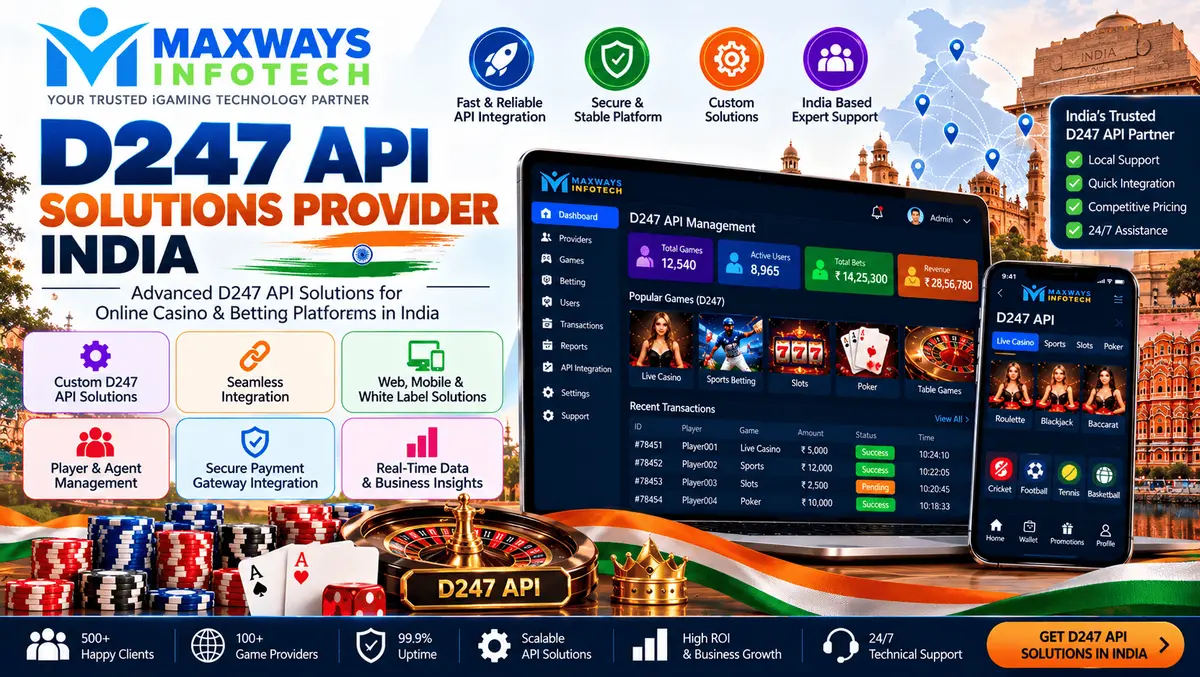
D247 API Solutions Provider India for custom API development, secure integration, data connectivity, testing, and technical support.
D247 API Solutions Provider India: Custom API Solutions, Integration, and Support
D247 API Solutions Provider India may help businesses evaluate API requirements, develop compatible solutions, implement authorized integrations, and maintain reliable software connectivity.
Choosing the right provider requires more than comparing development prices. Businesses should evaluate technical capabilities, API compatibility, security practices, documentation, and ongoing maintenance before selecting a solution.
At MaxWays Infotech, businesses can explore information about software development and digital platform solutions. This guide explains how to evaluate API solutions providers and plan a reliable integration project.
What Is a D247 API Solutions Provider?
An API solutions provider helps businesses design, develop, configure, or integrate application programming interfaces according to defined technical requirements.
Depending on the software and available documentation, a D247-related API project may involve connecting compatible applications, creating custom endpoints, synchronizing authorized data, or integrating a panel with an external service.
Typical services may include:
-
API requirement analysis and technical planning.
-
Custom API development and configuration.
-
Authorized third-party application integration.
-
Data mapping and validation.
-
Authentication and access-control implementation.
-
API testing, documentation, and deployment.
-
Monitoring, troubleshooting, and maintenance.
The actual capabilities depend on the specific software, available endpoints, provider permissions, and project scope. Businesses should confirm supported functionality before beginning development.
Key API Solutions to Consider
1. Custom API Development
Custom API development creates interfaces tailored to an application's requirements. Developers define endpoints, request parameters, response formats, authentication rules, and error-handling behaviour.
A well-designed API should have consistent naming conventions, predictable responses, clear documentation, and a structure that supports future enhancements.
2. API Integration Services
API integration connects compatible applications through existing, documented interfaces. It may involve configuring credentials, mapping data fields, validating requests, and testing communication between systems.
For additional background, explore the D247 API Development Company | Maxways Infotech which provides context about API connectivity for digital platforms.
3. Data Exchange and Synchronization
Connected applications may need to share information in real time or on a schedule. The appropriate approach depends on the API's capabilities, data volume, and operational requirements.
Developers should define which system controls each important data field and how conflicting updates, incomplete records, and repeated requests will be handled.
4. Backend and Database Connectivity
APIs often connect websites and applications with backend services or databases. This enables controlled access to information without exposing internal systems directly.
A suitable implementation should include input validation, appropriate database permissions, transaction handling where necessary, and clear error responses.
5. API Security Configuration
API security helps protect applications against unauthorized access and unintended data exposure.
Important safeguards include secure authentication, restricted permissions, protected credentials, encrypted communication, input validation, and appropriate audit logging.
6. API Monitoring and Maintenance
After deployment, integrations may need updates because of API version changes, software dependencies, security requirements, or external service interruptions.
Monitoring, documented troubleshooting procedures, and regular compatibility checks help maintain reliable connections.
Why Consider an API Solutions Provider in India?
Businesses evaluating an India-based provider may value regional project coordination, communication aligned with local business hours, or familiarity with the Indian technology market. However, location alone does not establish technical quality.
A provider should be assessed on its capabilities, transparency, documentation, security practices, and ability to support the project after deployment.
Clear Project Communication
A documented project scope helps define required endpoints, integrations, responsibilities, and delivery milestones.
Flexible Technical Planning
An experienced team can assess whether existing APIs meet the requirements or whether custom development is necessary.
Transparent Commercial Terms
A detailed proposal should identify development costs, third-party charges, hosting, maintenance, and future enhancement fees.
Ongoing Technical Support
Defined support arrangements help businesses understand how compatibility issues, security updates, and integration failures will be handled.
Businesses comparing broader software services can also review D247 API Integration Provider | Maxways Infotech for related technology and service considerations.
How to Choose the Right D247 API Solutions Provider
Review Technical Experience
Ask about the provider's experience with API architecture, backend programming, databases, authentication, data transformation, and automated testing.
A suitable provider should be able to explain its proposed architecture and identify technical limitations before development begins.
Verify API Compatibility
Request official documentation for the required APIs. Confirm that the necessary endpoints, permissions, credentials, and test environments are available.
Do not assume that every panel or external application supports every requested integration.
Evaluate Security Practices
Ask how the provider protects credentials, manages permissions, validates incoming requests, and handles vulnerabilities.
Security responsibilities should be clearly documented between the business, developer, hosting provider, and third-party service operators.
Check Documentation and Testing
Confirm that the final deliverables include API documentation, configuration instructions, test results, and troubleshooting guidance.
Define acceptance criteria so the completed solution can be evaluated against measurable requirements.
Compare Total Project Costs
The total cost may include API development, integration, testing, hosting, third-party subscriptions, monitoring, and maintenance.
Request an itemized quotation to understand which services are included and which require additional payment.
D247 API Implementation Process
A structured implementation process helps reduce technical risks and makes project progress easier to track.
-
Requirement analysis: Identify the applications, data flows, required endpoints, and expected outcomes.
-
Technical assessment: Review API documentation, permissions, authentication methods, and compatibility.
-
Solution design: Define the architecture, data mapping, security controls, and error-handling procedures.
-
Development and configuration: Build the required API or configure authorized integrations.
-
Testing and validation: Check successful requests, invalid inputs, permissions, timeouts, and recovery behaviour.
-
Deployment: Release the approved implementation in the intended environment.
-
Monitoring and maintenance: Track errors, update dependencies, and manage compatibility changes.
For projects that combine API connectivity with website development, explore D247 Panel Integration Services | Maxways Infotech for related technical planning information.
API Solutions for White-Label Platforms
White-label platforms generally use an existing software framework that can be presented under a business's branding, subject to the provider's terms.
API capabilities vary between solutions. Some platforms offer documented interfaces for supported integrations, while others require additional development or third-party approval.
Before selecting a white-label solution, confirm the available endpoints, customization limits, licensing conditions, and responsibility for ongoing maintenance.
Common API Development Challenges
API projects may encounter technical difficulties if dependencies and limitations are not addressed early.
-
Incompatible data formats: Establish clear data contracts and validation rules.
-
Authentication failures: Verify credentials and implement secure renewal procedures.
-
Rate limits: Follow documented API usage restrictions.
-
Duplicate requests: Use appropriate idempotency controls where supported.
-
Version changes: Test compatibility and plan migrations before retiring existing interfaces.
-
Network interruptions: Configure suitable timeouts, retries, and recovery procedures.
-
Insufficient documentation: Record dependencies, configuration settings, and troubleshooting steps.
A documented maintenance process helps teams respond consistently when problems occur.
API Integration for Specialized Data Applications
Some applications depend on specialized data services, where accuracy, availability, authorization, and update frequency are particularly important.
Before integrating such services, review the provider's documentation, data coverage, permitted use, request limits, and commercial terms.
For a related example, explore the Diamond Exchange API overview to understand considerations involved in connecting specialized applications through APIs.
Why Explore MaxWays Infotech?
Businesses researching API development and digital platform solutions can visit MaxWays Infotech to explore available company information and related technology topics.
Before choosing an API solutions provider, prepare a clear requirements document, verify API access, and review the proposed security, testing, deployment, and maintenance arrangements.
Frequently Asked Questions
What does a D247 API Solutions Provider in India do?
Depending on its services, a provider may develop APIs, connect compatible applications, configure authorized integrations, test data exchange, document endpoints, and maintain software connectivity.
Can a D247 API connect different applications?
Yes, when the applications provide compatible interfaces and the required access is authorized. The exact possibilities depend on available endpoints, documentation, and technical restrictions.
Is API integration secure?
It can be implemented securely through appropriate authentication, restricted permissions, protected credentials, input validation, encrypted communication, and monitoring.
How long does API development take?
The timeline depends on the number of endpoints, integration complexity, documentation quality, existing software, testing requirements, and third-party dependencies.
What should I ask an API solutions provider before hiring them?
Ask about technical experience, API compatibility, security practices, testing, documentation, project costs, licensing, and post-deployment support.
Does API software require ongoing maintenance?
Often, yes. API versions, credentials, software dependencies, and external services may change. Maintenance helps preserve compatibility and reliability.
Conclusion
Choosing a suitable D247 API Solutions Provider in India involves evaluating technical expertise, API compatibility, security, documentation, integration testing, and ongoing support. A clearly defined project scope helps businesses understand what will be delivered and how the solution will be maintained.D247 Panel Solutions Provider India | Maxways Infotech
Visit MaxWays Infotech to explore related software development information and plan your API project's technical requirements.
Compliance note: Any betting, casino, or gaming-related software must be developed and operated only where legally permitted and with all required licences and authorizations. Applicable age restrictions, responsible-use safeguards, privacy requirements, and data-protection obligations must also be followed.