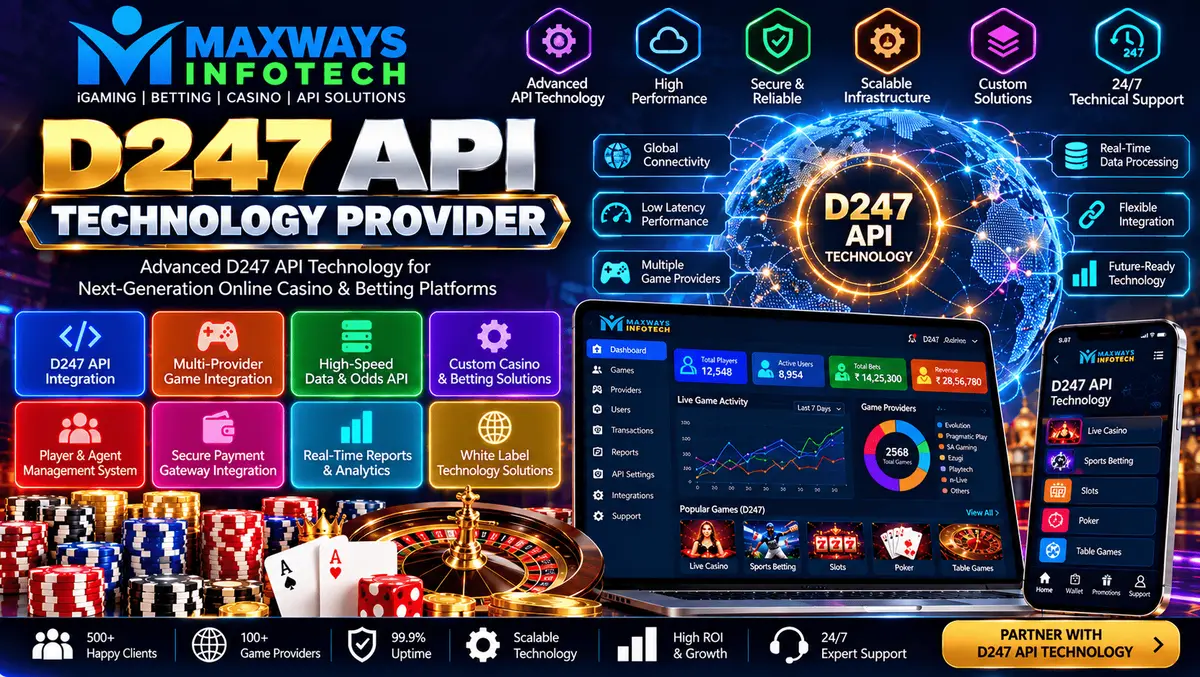
Explore D247 API technology provider services, API integration, system connectivity, testing, security practices, and technical support with MaxWays Infotech.
D247 API Technology Provider: API Integration and Digital Platform Connectivity
Modern digital platforms rely on reliable software connections to exchange information, coordinate services, and manage application workflows. An Application Programming Interface (API) helps different software systems communicate through defined rules and data formats. For businesses exploring D247-related technology, choosing a suitable D247 API Technology Provider involves evaluating integration requirements, documentation, security, testing, and long-term technical support.
MaxWays Infotech provides a starting point for exploring digital platform and software development services. Visit the MaxWays Infotech website to learn more about the company and its technology-related offerings.
What Is a D247 API Technology Provider?
A D247 API technology provider is a term used to describe a technology service provider that supports API-related requirements associated with a D247 platform or integration environment. Depending on the authorized API documentation and project scope, these requirements may involve application connectivity, data exchange, integration development, testing, or maintenance.
The exact functions available depend on the API owner's permissions, technical documentation, service agreements, and supported endpoints. Businesses should confirm these details before planning an implementation.
A technology provider may help teams with:
-
Reviewing API documentation and technical requirements.
-
Planning integration between compatible applications.
-
Mapping data fields and defining communication workflows.
-
Testing API responses and handling errors.
-
Reviewing authentication and access-control requirements.
-
Maintaining integrations as approved systems evolve.
For related technology information, explore MaxWays Infotech's overview of D247 API Integration Provider | Maxways Infotech
Why API Technology Matters for Digital Platforms
APIs create structured communication between software applications. Instead of building every function from scratch, a development team can connect compatible systems through documented interfaces when the necessary authorization is available.
1. Application Connectivity
API integration can connect separate applications and services through defined requests and responses. This helps developers organize system communication and reduce unnecessary manual data handling.
2. Structured Data Exchange
A properly designed integration defines how data is requested, validated, transmitted, and processed. Consistent formats and validation rules help reduce errors between connected applications.
3. Flexible Software Architecture
Modular API-based systems can make it easier to maintain individual components without rebuilding an entire application. The actual flexibility depends on the architecture, API limits, and the capabilities of the connected services.
4. Easier Troubleshooting
Logging, monitoring, error handling, and documented response codes can help technical teams investigate failed requests and identify integration issues more efficiently.
Key Services to Evaluate in a D247 API Technology Provider
When comparing providers, focus on the actual technical services offered rather than relying only on a service label.
API Integration Planning
The first step is to understand the intended workflow, source systems, destination systems, data formats, and access permissions. A written integration plan should identify dependencies and expected outcomes before development begins.
Custom API Development
Some projects require a new API layer to connect existing applications or expose approved business functions. Development may include endpoint design, request validation, response formatting, authentication, and error handling.
The required scope should be documented clearly, including what is included in development and what depends on third-party systems.
Integration Testing
Testing should cover successful requests, invalid inputs, authorization failures, timeouts, unexpected responses, and service interruptions. Where applicable, teams should use an approved sandbox or test environment before production deployment.
Security and Access Management
API implementations should use appropriate authentication, least-privilege access, secure transport, secret management, rate limiting, and monitoring. Sensitive data should only be exchanged when permitted and necessary.
Maintenance and Technical Support
API versions, service limits, and third-party dependencies may change. A maintenance plan should define how updates are reviewed, integration failures are handled, and compatibility is tested.
Businesses evaluating broader software capabilities can also reviewD247 API Solutions Provider India | Maxways Infotech to understand related platform development considerations.
How to Evaluate API Compatibility Before Integration
Not every API is compatible with every application. Before selecting a D247 API technology provider, ask for evidence that the intended integration is supported and authorized.
Review the Official Documentation
Check the API owner's documentation for available endpoints, supported methods, required parameters, response formats, authentication, usage limits, and versioning rules.
Confirm Access and Authorization
Verify that the organization has permission to use the API and that the provider is authorized to perform the proposed work. Do not assume that a service name or marketing claim proves official access.
Define Data Requirements
Identify what information needs to move between systems, how frequently it must be updated, and how errors or incomplete responses should be handled.
Test Before Production
Use authorized test credentials and a sandbox where available. Validate ordinary workflows as well as timeouts, rate limits, expired credentials, and service failures.
Document Ownership and Support
Agree on who manages credentials, monitors integrations, applies updates, responds to incidents, and maintains the code. Clear ownership reduces confusion after deployment.
D247 API Technology Provider for Platform Integration
A technology provider may assist with planning an integration between compatible software components, provided the required access and permissions are in place. Typical project stages include requirement analysis, architecture planning, implementation, testing, deployment, and maintenance.
A practical implementation process can follow these steps:
-
Requirement analysis: Define the business objective and the systems that need to communicate.
-
Documentation review: Confirm the API's supported capabilities, limitations, and access requirements.
-
Technical design: Plan authentication, data mapping, error handling, logging, and system dependencies.
-
Development: Build the integration using approved endpoints and documented methods.
-
Quality assurance: Test security, compatibility, performance, and failure scenarios.
-
Deployment: Release the integration through an approved deployment process.
-
Monitoring: Review errors, service health, version changes, and maintenance needs.
The appropriate implementation depends on the actual API specification. A provider should not promise features, data access, or integrations that the API owner does not support.
API Integration and White-Label Platform Considerations
Some businesses investigate API integration alongside white-label or configurable platform options. These are related but different approaches: an API connects software components, while a white-label solution generally involves adapting an existing product for use under a business's branding, subject to the relevant agreement.
Before combining these approaches, review licensing, customization rights, data ownership, hosting responsibilities, support arrangements, and any third-party restrictions.
For additional background, read about white-label iGaming API integration. The suitability of any integration will depend on documented functionality and the permissions granted by the relevant service owner.
Common Challenges in API Technology Projects
Even a well-planned integration can face technical challenges. Identifying them early helps teams plan realistic timelines and support processes.
-
Authentication errors: Incorrect credentials, expired tokens, or missing permissions may prevent requests from succeeding.
-
Data mismatches: Different field names, formats, or validation rules can cause processing failures.
-
Rate limits: Excessive requests may be throttled or rejected under the API provider's usage policies.
-
Version changes: Updated endpoints or response formats can affect existing integrations.
-
Service interruptions: Timeouts and unavailable dependencies require sensible retry and recovery strategies.
-
Insufficient monitoring: Missing logs or alerts can make problems harder to diagnose.
A suitable implementation should include documented error handling, security controls, monitoring, and a process for testing changes before they reach production.D247 Panel Technology Provider | Maxways Infotech
Why Consider MaxWays Infotech?
When assessing a technology partner, businesses should look for clear communication, a documented project scope, realistic delivery commitments, and transparent technical support arrangements.
Before entering an agreement, confirm the provider's relevant experience, authorized access to the required API, deliverables, security practices, support terms, and responsibilities for third-party dependencies. These checks are more useful than relying on a provider label alone.
Frequently Asked Questions
1. What does a D247 API technology provider do?
The term generally refers to a provider offering technical assistance for API-related integration or development connected with a D247 environment. The exact services depend on the official API documentation, authorization, and project agreement.
2. What should I check before choosing a D247 API technology provider?
Review documentation, supported endpoints, authorization, security practices, integration experience, testing methods, maintenance commitments, and the provider's ability to explain project limitations.
3. Can a D247 API be integrated with an existing application?
Integration may be possible when the API supports the required workflow, the applications are technically compatible, and the required access is authorized. Compatibility should be confirmed through documentation and testing.
4. Is API integration the same as API development?
No. API development involves creating or extending an API, while API integration connects applications using an existing or newly developed interface. A project may require one or both.
5. How can API integration security be improved?
Use approved authentication methods, encrypted connections, least-privilege access, secure credential storage, input validation, monitoring, and regular security reviews. Avoid exposing credentials or sensitive information in logs.
6. Why is API testing important?
Testing helps identify compatibility issues, invalid responses, authentication problems, performance limitations, and failure scenarios before production deployment.
7. Does an API technology provider guarantee uninterrupted service?
No provider can guarantee that every external service will remain continuously available. Service reliability depends on the API owner, infrastructure, network conditions, implementation quality, and agreed service-level commitments.
Conclusion
Selecting a D247 API Technology Provider requires more than comparing service descriptions. Businesses should assess API compatibility, documented capabilities, authorization, security controls, testing procedures, and ongoing support before committing to an integration project.D247 Panel Integration Services | Maxways Infotech
MaxWays Infotech can be explored as a starting point for reviewing related software and platform technology offerings. Visit MaxWays Infotech to review the company's published information and assess whether its services fit your project's requirements.
Compliance note: Any gaming-related API or platform integration should be used only where legally permitted, with the required licences and authorizations, appropriate age safeguards, responsible-use measures, and applicable privacy and data-protection controls.