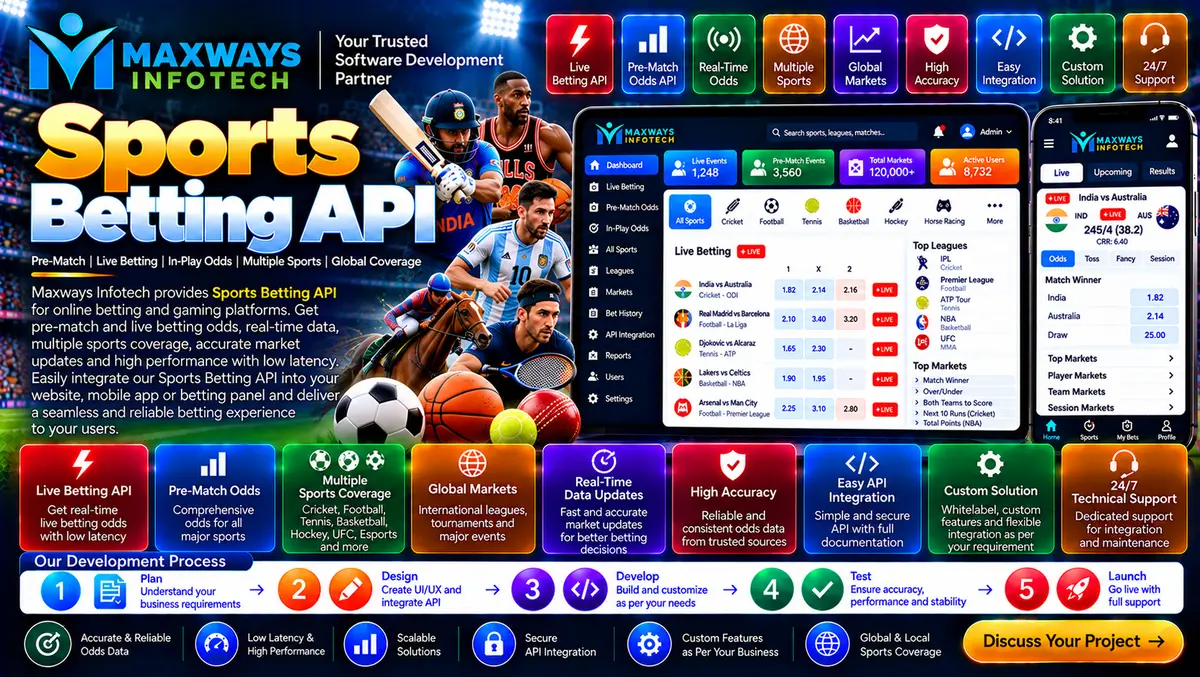
Explore Sports Betting API integration, account management, payment workflows, transaction consistency, API security, documentation, testing, and compliance considerations.
Sports Betting API: Platform Integration, Account Management and System Design
A Sports Betting API connects the software services that support a sports betting platform, allowing authorised systems to exchange information through documented interfaces. Depending on the provider, these interfaces may support sports events, user accounts, payment records, market information, transaction processing, reporting, and other platform functions.
For developers, the main challenge is coordinating these services without allowing one system's failure to create inconsistent records in another. A sports data service may update an event while an account service is processing a request. A payment notification may arrive after a timeout. An audit report may need to explain why a transaction changed status.
These situations require clear data ownership, secure communication, reliable transaction handling, and well-defined integration rules. This guide explains the technical considerations involved in planning a Sports Betting API integration.
What Is a Sports Betting API?
A Sports Betting API is an interface that allows software applications to communicate with sports betting-related services. The scope depends on the provider: some APIs supply sports data, while broader platform APIs connect several operational functions.
A project may use separate interfaces for:
-
Sports event data: Fixtures, competitions, participants, and event status.
-
Market information: Supported market definitions, selections, and price data.
-
Account management: User records, authentication, and account status.
-
Payment services: Payment requests, transaction references, and status notifications.
-
Reporting: Operational summaries, reconciliation records, and audit information.
-
Compliance controls: Identity checks, access restrictions, and user-protection settings where applicable.
Not every API includes all these functions. Before planning the software, developers should identify which services the provider supplies and which responsibilities remain with the application owner.
Businesses researching their software requirements can begin with the Maxways Infotech homepage to review the company's published information.
Understanding the Different API Layers
A platform that appears to users as a single application may contain several independent services. Each service should have a clearly defined purpose and an agreed method for exchanging information.
Sports data API
This interface provides information about supported events and competitions. Its data model should distinguish between an event's identity, its current status, and any associated market information.
Account management API
The account layer manages user identity and access. It should define how accounts are created, updated, suspended, or restricted and how other services verify account status.
Payment integration API
A payment interface connects the application to an authorised payment provider. It may return transaction references, processing states, and notifications about completed or failed operations.
Platform administration API
Administrative interfaces allow authorised staff to manage permitted settings, review operational records, and investigate issues. Administrative actions should be subject to access controls and audit logging.
Reporting API
Reporting interfaces expose information needed for reconciliation, operational monitoring, and management reports. Reporting should use reliable source records rather than treating cached dashboard values as the final authority.
The key design principle is that each service should own its data and expose only the operations required by other components.
How API Integration Works Across a Platform
A well-structured integration establishes a predictable path for requests and responses.
A simplified architecture looks like this:
Web or mobile application → API gateway → Authentication and validation → Relevant service → Database or external provider → Response
The API gateway can provide a central point for routing, access policies, and request limits. Authentication identifies the caller, while authorisation determines which operations that caller may perform.
The relevant service then validates the request and processes it according to its own business rules. The response should communicate a clear result, including an appropriate error when the request cannot be completed.
For example, an event-information request should not use the same error-handling assumptions as a payment operation. Retrieving information is generally different from creating a financial transaction, and each operation needs its own consistency and retry rules.
User Identity and Access Management
When several services share account information, they need a consistent approach to identity and permissions.
A typical design includes a unique internal account identifier, authentication credentials or tokens, an account status, and role-based permissions. External providers may also have their own identifiers, which should be mapped to the internal account without assuming the values are interchangeable.
Important controls include:
-
Secure authentication and session management.
-
Least-privilege permissions for users and services.
-
Appropriate account verification where legally required.
-
Protection against unauthorised account changes.
-
Rate limits on sensitive endpoints.
-
Audit records for significant administrative actions.
Account restrictions must be enforced by the backend. Hiding a button in the user interface is not sufficient if the same operation remains accessible through a direct API request.
Payment Workflow and Transaction Consistency
Payment integrations require special care because a request can time out even after the external provider has received it.
Consider a hypothetical transaction. The application sends a request, the payment provider processes it, but the response is delayed. If the application immediately repeats the request without checking its status, it may create a duplicate operation.
A safer workflow uses several controls.
Unique transaction references: Each operation should have a reference that can be used to trace it across connected services.
Idempotency: Where supported, an idempotency key helps ensure that retrying the same logical request does not create an unintended duplicate.
Explicit transaction states: The application should distinguish between states such as pending, completed, failed, and reversed according to the provider's documented model.
Verified notifications: Webhook messages should be authenticated and processed safely, including when the provider retries a notification.
Reconciliation: The application should compare its records with the payment provider's authoritative transaction records and investigate unresolved differences.
Financial records should not rely solely on cached balances or dashboard displays. The system of record must determine the authoritative transaction state.
API Documentation, Versioning and Error Handling
An API integration becomes easier to maintain when the provider documents its endpoints, schemas, authentication requirements, limits, and error responses.
Developers should examine the documentation for:
-
Request and response formats.
-
Required and optional fields.
-
Authentication and permission requirements.
-
Rate limits and quota behaviour.
-
Error codes and retry guidance.
-
Webhook verification and delivery rules.
-
Versioning and deprecation policies.
-
Sandbox availability and test scenarios.
Versioning is especially important when a provider changes field names, status values, or response structures. A controlled upgrade process allows developers to test the new contract before moving production traffic.
Error handling should also be specific to the operation. A temporary server error may justify a controlled retry, while an authentication failure usually requires a configuration fix. A timeout during a financial operation may require a status check before another request is attempted.
Security and Data Protection
A Sports Betting API can connect several services that handle account information, operational records, or financial data. Security therefore needs to be considered across the entire integration.
Credential protection: Keep secret API keys on the server and out of public frontend code.
Transport security: Use encrypted connections for communications between the application, providers, and internal services.
Input validation: Validate incoming parameters and messages before processing them.
Permission controls: Restrict each service to the endpoints and records it needs.
Secret-safe logging: Avoid writing passwords, access tokens, payment credentials, or unnecessary sensitive information into logs.
Monitoring: Record authentication failures, unexpected request volumes, and other meaningful security events.
Data retention: Keep records according to documented business, contractual, and legal requirements.
For projects involving payment systems, financial workflows, or other data-intensive applications, the Maxways Infotech fintech page is a relevant place to explore related software development information.
Compliance and User-Protection Requirements
Technical readiness does not automatically establish permission to operate a betting-related service. Requirements depend on the intended jurisdiction, the product's functionality, the provider agreements, and applicable law.
Where relevant, a platform may need to consider age and identity verification, access restrictions, transaction monitoring, privacy controls, audit records, and responsible-use features.
User-protection features can include configurable spending or deposit limits, session reminders, cooling-off periods, and self-exclusion controls where appropriate. If such controls are required, they should be enforced consistently across the relevant services rather than implemented only in the interface.
Before launching or distributing a betting-related application, obtain appropriate legal review and verify that the planned use of third-party data and payment services is authorised.
Testing a Sports Betting API Integration
Testing should examine how services behave when requests succeed, fail, time out, or arrive more than once.
A practical test plan includes the following:
Use a sandbox or simulated responses when available. Testing only successful requests is not enough to establish that an integration can recover safely from real-world failures.
Common Mistakes to Avoid
Assuming one API provides every service
A sports data API may not include account management, payment processing, reporting, or compliance functionality. Confirm the actual service scope before estimating development work.
Treating every timeout as a failed transaction
A timeout indicates that the response was not received in time; it does not necessarily prove that the operation failed. Check the transaction's state before retrying consequential requests.
Allowing different services to create conflicting records
Assign clear ownership to accounts, transactions, and event records. Other services should refer to the authoritative identifier rather than create competing versions.
Ignoring API version changes
Changes in field names, response formats, and status values can break integrations. Use documented versioning and test updates before deployment.
Leaving security until the end
Authentication, access control, audit requirements, and data retention can affect the architecture. Plan them alongside the main API workflows.
Frequently Asked Questions
What is a Sports Betting API used for?
It connects authorised applications with sports data or platform services. The available functions depend on the provider and may include event data, account operations, payment interfaces, and reporting.
Is a Sports Betting API the same as a Sports Odds API?
Not necessarily. A Sports Odds API generally focuses on odds-related data, while a broader Sports Betting API may connect additional platform functions. The exact scope depends on the provider.
How can developers prevent duplicate payment requests?
They can use unique transaction references, supported idempotency mechanisms, explicit transaction states, verified notifications, and reconciliation procedures.
Why is API documentation important?
Documentation defines how requests, responses, authentication, errors, and version changes should be handled. It reduces integration assumptions and makes troubleshooting easier.
What should be checked before selecting a provider?
Review API coverage, documentation, supported operations, security, service limits, error handling, versioning, support arrangements, data permissions, and applicable legal requirements.
For more technical articles and software-related information, visit the Maxways Infotech blog.
Conclusion
A Sports Betting API integration is a coordinated software project, not simply a connection to one endpoint. Reliable account management, consistent transaction records, clear service responsibilities, secure communication, and thorough testing are essential to a maintainable system.
Before development begins, document which functions the provider supplies, identify the authoritative source for each important record, and define how failures and retries will be handled. This preparation makes the integration easier to test, troubleshoot, and maintain.
Always verify provider permissions, data rights, and applicable legal requirements before deploying betting-related functionality.